On Saturday I enjoyed the Met's highly lauded production of Gluck's Orfeo ed Euridice—projected "live" at a movie theater in Farmingdale, Long Island.
There will be two more performances of this short and sweet production this season: One on Wednesday night and the other on Saturday night. Catch one if you can!
The current production won its star, Stephanie Blythe, a rave from Anthony Tommasini at The New York Times. "With each performance the American mezzo-soprano Stephanie Blythe gives, it becomes increasingly apparent that a once-in-a-generation opera singer has arrived," is how it starts. "Who knows what roles Ms. Blythe might take on next. I would hear her sing absolutely anything. How about a new opera written expressly for this exciting artist who is just entering her prime?" is how it ends.
But there's more to the production than that. Blythe's well-cast Euridice, Danielle de Niese, sang beautifully—especially in her duet with Blythe during their passage out of Hades. The direction and choreography, by Mark Morris, didn't win me over in the early parts of the opera (perhaps they worked better live than on camera), but everything came together beautifully as the opera progressed.
To get back to Tommasini's remark that a new opera should be written expressly for Blythe, I just thought I'd mention again that, although my friend Paul Siskind's opera The Sailor-Boy and the Falcon wasn't built around her, he wrote her part knowing that she would be performing it—and she sounded (and acted) great in her role.
Showing posts sorted by relevance for query stephanie blythe. Sort by date Show all posts
Showing posts sorted by relevance for query stephanie blythe. Sort by date Show all posts
Tuesday, January 27, 2009

Saturday, December 02, 2006
THE GENESIS OF AN OPERA. Where do operas come from? Here's a short version--a very short version....
In 1978 my sister went to college at SUNY Binghamton. At some point she brought home a short story anthology called Affinities, which I promptly (and permanently) borrowed. One story that cast a spell on me was "The Sailor-Boy’s Tale" by Isak Dinesen. (Dinesen is a pseudonym of Danish author Karen Blixen, who is now best known as the author of "Babette’s Feast" and Out of Africa.)
In 1979 I joined the Long Island Youth Orchestra, where, as a member of the Lower Brass Union (LBU), I made the acquaintance of a talented tuba player named Paul Siskind. As is often the case among members of the LBU, we spent much rehearsal time simply waiting to play. I often passed that time immersed in reading. (A Portrait of the Artist as a Young Man was one book I devoured with strings played in the background.) Paul, on the other hand, paid more attention to the music and thoughtfully nudged me when it was my turn to make an entrance. So perhaps it is not surprising that Paul became a musician and I became a writer.
Paul and I remained friends as we followed our different paths, usually (but not always) in different cities. At some point--during the Eighties, I think--I was struck by the idea that "The Sailor-Boy’s Tale" would make a good operetta or opera. It’s a very short, sketchy story that resembles a folk tale. Without giving away details, I’ll note that the story includes many elements that seem to lend themselves to a good piece of musical theater--romance, action, the occult, changing moods, some surprises, and a variety of settings and situations running from solitary shipboard brooding to a bustling marketplace.
 Every now and then I’d mention the story and its operatic potential to Paul--and after many years he also saw the light and got the "okay" to adapt the story as an opera for a premiere staging at the Crane School of Music at SUNY Potsdam, where he is known to many as Dr. Siskind (left). Another SUNY Potsdam professor, Alan Steinberg--who teaches Dinesen’s story himself--became the librettist.
After many intense months of composition and the shedding of copious quantities of blood, sweat, and tears, The Sailor-Boy and the Falcon finally premiered last month. A friend and I traveled upstate for two of the performances and really enjoyed seeing the story staged after all these years. It was also fascinating to see the impact of this operatic production on the school and town. A production of this kind gives many people a chance to shine, involving vocal and instrumental music, acting, dancing, set design, lighting, stage management, rehearsal pianists, etc. The participation of Metropolitan Opera mezzo-soprano and Crane graduate Stephanie Blythe, who performed as Sunniva and graciously interacted with the student performers, further enriched the experience. And the four sold-out performances and related events engaged many others, including Crane students, school children and townspeople, music business professionals, and so forth.
When Dinesen’s little story was published in her collection Winter’s Tales in 1942, no one could have imagined what a life it would go on to have. Queen Margrethe II of Denmark apparently adapted it for marionette theater in 2004. And it somehow came to be adopted within the SUNY system, where it blossomed into The Sailor-Boy and The Falcon in 2006. I hope that the opera will thrive, giving many others the opportunity to experience its magic.
A live recording of The Sailor-Boy and the Falcon will be broadcast on North Country Public Radio today from 1 – 3 pm EST.
Stephanie Blythe performs a recital this Thursday evening at Carnegie’s Zankel Hall.
In 1978 my sister went to college at SUNY Binghamton. At some point she brought home a short story anthology called Affinities, which I promptly (and permanently) borrowed. One story that cast a spell on me was "The Sailor-Boy’s Tale" by Isak Dinesen. (Dinesen is a pseudonym of Danish author Karen Blixen, who is now best known as the author of "Babette’s Feast" and Out of Africa.)
In 1979 I joined the Long Island Youth Orchestra, where, as a member of the Lower Brass Union (LBU), I made the acquaintance of a talented tuba player named Paul Siskind. As is often the case among members of the LBU, we spent much rehearsal time simply waiting to play. I often passed that time immersed in reading. (A Portrait of the Artist as a Young Man was one book I devoured with strings played in the background.) Paul, on the other hand, paid more attention to the music and thoughtfully nudged me when it was my turn to make an entrance. So perhaps it is not surprising that Paul became a musician and I became a writer.
Paul and I remained friends as we followed our different paths, usually (but not always) in different cities. At some point--during the Eighties, I think--I was struck by the idea that "The Sailor-Boy’s Tale" would make a good operetta or opera. It’s a very short, sketchy story that resembles a folk tale. Without giving away details, I’ll note that the story includes many elements that seem to lend themselves to a good piece of musical theater--romance, action, the occult, changing moods, some surprises, and a variety of settings and situations running from solitary shipboard brooding to a bustling marketplace.
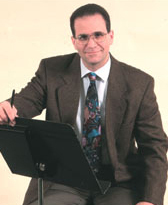 Every now and then I’d mention the story and its operatic potential to Paul--and after many years he also saw the light and got the "okay" to adapt the story as an opera for a premiere staging at the Crane School of Music at SUNY Potsdam, where he is known to many as Dr. Siskind (left). Another SUNY Potsdam professor, Alan Steinberg--who teaches Dinesen’s story himself--became the librettist.
 After many intense months of composition and the shedding of copious quantities of blood, sweat, and tears, The Sailor-Boy and the Falcon finally premiered last month. A friend and I traveled upstate for two of the performances and really enjoyed seeing the story staged after all these years. It was also fascinating to see the impact of this operatic production on the school and town. A production of this kind gives many people a chance to shine, involving vocal and instrumental music, acting, dancing, set design, lighting, stage management, rehearsal pianists, etc. The participation of Metropolitan Opera mezzo-soprano and Crane graduate Stephanie Blythe, who performed as Sunniva and graciously interacted with the student performers, further enriched the experience. And the four sold-out performances and related events engaged many others, including Crane students, school children and townspeople, music business professionals, and so forth.
When Dinesen’s little story was published in her collection Winter’s Tales in 1942, no one could have imagined what a life it would go on to have. Queen Margrethe II of Denmark apparently adapted it for marionette theater in 2004. And it somehow came to be adopted within the SUNY system, where it blossomed into The Sailor-Boy and The Falcon in 2006. I hope that the opera will thrive, giving many others the opportunity to experience its magic.
A live recording of The Sailor-Boy and the Falcon will be broadcast on North Country Public Radio today from 1 – 3 pm EST.
Stephanie Blythe performs a recital this Thursday evening at Carnegie’s Zankel Hall.
Friday, February 20, 2009
Gotham Chamber Opera: L'isola disabitata (The Desert Island)
Mark Morris Directs Haydn Mini-Opera
After a season of relatively experimental productions, the Gotham Chamber Opera returns to its core strength with its entertaining production of Haydn's L'isola disabitata (The Desert Island) at the Gerald W. Lynch Theater at John Jay College.
Directed by Mark Morris (and attended on opening night by Stephanie Blythe), L'isola desabitata tells the simple-for-opera story of Costanza (Takesha Meshé Kizart) and Silvia (Valerie Ogbonnaya), shipwrecked sisters left to fend for themselves on a desert island after pirates had abducted Costanza's husband Gernando (Vale Rideout). Costanza, who mistakenly believes that Gernando had abandoned herself, has raised Silvia to hate and fear men. But the reappearance of Gernando, together with his steadfast friend Enrico (Tom Corbeil), challenges Costanza and the innocent Silvia to reconsider their points of view.
Sensitively accompanied under the conductorship of Gotham artistic director Neal Goren, the four singers cavort on and about a rotating "desert island" set. They work well as a group negotiating a reworked Haydn score that tests their vocal and expressive ranges, with Ogbonnaya standing out with her charming singing and acting.
I can quibble over various aspects of the production, including the way that dance gestures suddenly asserted themselves toward the finale—fascinating to behold, they nevertheless made me wonder whether director Morris had only been able to do so much prior to opening night. And I could imagine certain musical portions (such as the overture) being enhanced through stagecraft (such as a slide show depicting the opera's backstory). But this entertaining and satisfying production of a rarely performed work is yet another example of what makes the Gotham Chamber Opera a vital player in New York City's music scene.
Remaining dates (all at 8 pm) are Saturday, February 21; Wednesday, February 25; Friday, February 27; and Saturday, February 28, 2009. The running time of the intermission-free production is about 105 minutes, or about 90 minutes if it starts on time.
After a season of relatively experimental productions, the Gotham Chamber Opera returns to its core strength with its entertaining production of Haydn's L'isola disabitata (The Desert Island) at the Gerald W. Lynch Theater at John Jay College.
Directed by Mark Morris (and attended on opening night by Stephanie Blythe), L'isola desabitata tells the simple-for-opera story of Costanza (Takesha Meshé Kizart) and Silvia (Valerie Ogbonnaya), shipwrecked sisters left to fend for themselves on a desert island after pirates had abducted Costanza's husband Gernando (Vale Rideout). Costanza, who mistakenly believes that Gernando had abandoned herself, has raised Silvia to hate and fear men. But the reappearance of Gernando, together with his steadfast friend Enrico (Tom Corbeil), challenges Costanza and the innocent Silvia to reconsider their points of view.
Sensitively accompanied under the conductorship of Gotham artistic director Neal Goren, the four singers cavort on and about a rotating "desert island" set. They work well as a group negotiating a reworked Haydn score that tests their vocal and expressive ranges, with Ogbonnaya standing out with her charming singing and acting.
I can quibble over various aspects of the production, including the way that dance gestures suddenly asserted themselves toward the finale—fascinating to behold, they nevertheless made me wonder whether director Morris had only been able to do so much prior to opening night. And I could imagine certain musical portions (such as the overture) being enhanced through stagecraft (such as a slide show depicting the opera's backstory). But this entertaining and satisfying production of a rarely performed work is yet another example of what makes the Gotham Chamber Opera a vital player in New York City's music scene.
Remaining dates (all at 8 pm) are Saturday, February 21; Wednesday, February 25; Friday, February 27; and Saturday, February 28, 2009. The running time of the intermission-free production is about 105 minutes, or about 90 minutes if it starts on time.
Subscribe to:
Posts (Atom)


 Posts
Posts

