One of the movie highlights of the year so far is the Film Forum screening of the well-paced Japanese epic The Human Condition. I saw the first part last night and frequently felt myself in the presence of greatness. Part 1 shows only one more time during this run, on Sunday—check the schedule here—but it might also be available via NetFlix.
Part 1 revolves around the idealistic Kaji (Tatsuya Nakadai), who accepts an assigment supervising a labor camp in occupied Manchuria. Keeping him out of combat service, this decision gives him enough hope for the future to marry his girlfriend Michiko (Michiyo Aratama), but it also thrusts him into an impossible situation, trying to apply his ideals to prison labor under a military regime.
Kaji's nightmarish predicament is the stuff of gripping drama, and its particulars make The Human Condition something of a revelation to me. Here is a major Japanese production, released from 1959 through 1961, that portrays Japanese human rights abuses against Chinese people, even showing the use of "comfort women." For the past decade or so, I have thought that Japan was largely in denial about its practices—if so, then it has somehow forgotten about this highly acclaimed movie despite its riveting plot, important themes, excellent acting, and artful cinematography, all under the direction of Masaki Kobayashi, a pacifist sent to Manchuria during the war.
The Human Condition is notorious for its length. Each of its three parts exceeds three hours, not including the intermissions. But the pacing of Part 1 is fast, almost to a fault—some cuts are so abrupt that they might lead you to think that sections are absent or reels mixed up. Even with the sporadic choppiness—and sporadic hamminess—the movie offers a powerful depiction of idealism in a world of compromise and brutality. Watching it, I mused over its parallels to the Dogs, Do You Want to Live Forever?, a 1959 German movie critical of Hitler's invasion of Stalingrad. And now I realize that it also has an affinity with Luis Buñuel's Viridiana (1961) as well as the lesser-known Fever Rises in El Pao (1961). Look at the years—was there an international cinematic Zeitgeist at work? I might as well note that Catch-22 came out in 1961 as well.
Source (4:33)
Showing posts with label Bunuel. Show all posts
Showing posts with label Bunuel. Show all posts
Thursday, July 31, 2008

Friday, June 27, 2008
BUÑUELIANA
I thought I'd seen just about everything that Luis Buñuel committed to film, but I found this while looking over the offerings in MOMA's Dalí: Painting and Film exhibition:
Spoilers: The film shows Mr. and Mrs. Dalí spending time together in a cliffside residence. One well-composed(!) shot shows them ascending a set of terraces, with unidentified people on the shore behind them. The climax comes with the meal of urchins, in which Mrs. Dalí pours what appears to be wine for Mr. Dalí, who indicates his approval of the culinary experience.
I thought I'd seen just about everything that Luis Buñuel committed to film, but I found this while looking over the offerings in MOMA's Dalí: Painting and Film exhibition:
Menjant Garotes (Eating Sea Urchins). 1930. Spain. Directed by Luis Buñuel. While on location in Cadaqués to shoot scenes for L'Age d'or (1930), Buñuel made this home movie featuring Dalí's estranged father and stepmother in an intimate moment: dining alfresco on sea urchins, a local delicacy. The iconographic sea urchin also appears in Un Chien andalou (1929), as well as in Dalí's paintings of the late 1920s. Print courtesy Filmoteca de Catalunya-ICIC. 4 min.You won't find this surprisingly charming "home movie" at IMDB (at present), but you have a chance to see it tonight courtesy of Rooftop Films.
Spoilers: The film shows Mr. and Mrs. Dalí spending time together in a cliffside residence. One well-composed(!) shot shows them ascending a set of terraces, with unidentified people on the shore behind them. The climax comes with the meal of urchins, in which Mrs. Dalí pours what appears to be wine for Mr. Dalí, who indicates his approval of the culinary experience.
Tuesday, May 29, 2007
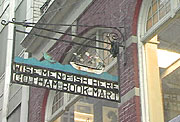
WISE MEN FISHED THERE
When I went to work in New York City in the 1980s, my office was only a short walk from the Gotham Book Mart. Since that time, I've never been far from it for long.
At first glance, the Gotham Book Mart didn't look very different from other successful used book stores: It was dim and a little dingy and stuffed with books, books, books.
It was in the details that the bookstore came alive for me and the many visitors I brought there: the sign that said Wise Men Fish Here; the shelves devoted to Henry Miller and Beat writers; the illustrated envelopes and other Edward Gorey curiosities displayed upstairs; the photographs of the many literary greats with some connection to the bookstore; the handouts about the history of the bookstore and its founder, Frances Steloff, who bravely sold Miller's novels when they were banned in the United States. And of course there were the finds, such as my copy of The Tibetan Book of the Dead stamped "From the Library of ANAIS NIN AND IAN HUGO" and marked down from $6.95 to $3.00. And then there was the possibility that Steloff herself might be there, or that one might bump into an author. In the later years of the bookstore it was home to a cat named Pynchon; perhaps, during one of my visits, I rubbed elbows with another cat named Pynchon.
Around the same period that Coliseum Books relocated to the Bryant Park area before meeting its demise, the Gotham Book Mart moved from 47th Street to an attractive new home on 46th Street. But it was only a waystation to oblivion courtesy of cosmetics billionaire Leonard Lauder and real estate developer Edmondo Schwartz, who have apparently been very secretive about "saving" the bookstore, closing it down due to non-payment of rent, and then taking possession of its books through a sudden auction that seems to have been rigged in their favor. At first, Gotham Book Mart owner Andreas Brown seemed grateful to Lauder and Schwartz for providing the store with a fancy new home, but at the moment and from a distance, Lauder and Schwartz seem to have been pretty ruthless in this dealing. Brown reportedly left the auction early, with tears in his eyes.
The debacle makes me think of a poem called "The Host" from Samuel Menashe's collection The Niche Narrows.
When I went to work in New York City in the 1980s, my office was only a short walk from the Gotham Book Mart. Since that time, I've never been far from it for long.
At first glance, the Gotham Book Mart didn't look very different from other successful used book stores: It was dim and a little dingy and stuffed with books, books, books.
It was in the details that the bookstore came alive for me and the many visitors I brought there: the sign that said Wise Men Fish Here; the shelves devoted to Henry Miller and Beat writers; the illustrated envelopes and other Edward Gorey curiosities displayed upstairs; the photographs of the many literary greats with some connection to the bookstore; the handouts about the history of the bookstore and its founder, Frances Steloff, who bravely sold Miller's novels when they were banned in the United States. And of course there were the finds, such as my copy of The Tibetan Book of the Dead stamped "From the Library of ANAIS NIN AND IAN HUGO" and marked down from $6.95 to $3.00. And then there was the possibility that Steloff herself might be there, or that one might bump into an author. In the later years of the bookstore it was home to a cat named Pynchon; perhaps, during one of my visits, I rubbed elbows with another cat named Pynchon.
Around the same period that Coliseum Books relocated to the Bryant Park area before meeting its demise, the Gotham Book Mart moved from 47th Street to an attractive new home on 46th Street. But it was only a waystation to oblivion courtesy of cosmetics billionaire Leonard Lauder and real estate developer Edmondo Schwartz, who have apparently been very secretive about "saving" the bookstore, closing it down due to non-payment of rent, and then taking possession of its books through a sudden auction that seems to have been rigged in their favor. At first, Gotham Book Mart owner Andreas Brown seemed grateful to Lauder and Schwartz for providing the store with a fancy new home, but at the moment and from a distance, Lauder and Schwartz seem to have been pretty ruthless in this dealing. Brown reportedly left the auction early, with tears in his eyes.
The debacle makes me think of a poem called "The Host" from Samuel Menashe's collection The Niche Narrows.
I am hauntedI know this poem because of the Gotham Book Mart. One of the last times I was there I had finally snagged a hard-to-find book about Luis Buñuel when I got into a conversation with a lovely saleswoman and Menashe, who told me about serving in World War II and gave me a personal reading from The Niche Narrows in a successful effort to sell it to me. I admit I love the prices at Amazon, but it's no substitute for that type of bookstore encounter, which is an increasingly rare experience.
Out of my house
Gaunt, dispossessed
By the homeless dead
These ghosts, guests
Have bled me white
No marrow is left
In the bone they bite
Subscribe to:
Posts (Atom)


 Posts
Posts