I thought I'd seen just about everything that Luis Buñuel committed to film, but I found this while looking over the offerings in MOMA's Dalí: Painting and Film exhibition:
Menjant Garotes (Eating Sea Urchins). 1930. Spain. Directed by Luis Buñuel. While on location in Cadaqués to shoot scenes for L'Age d'or (1930), Buñuel made this home movie featuring Dalí's estranged father and stepmother in an intimate moment: dining alfresco on sea urchins, a local delicacy. The iconographic sea urchin also appears in Un Chien andalou (1929), as well as in Dalí's paintings of the late 1920s. Print courtesy Filmoteca de Catalunya-ICIC. 4 min.
Spoilers: The film shows Mr. and Mrs. Dalí spending time together in a cliffside residence. One well-composed(!) shot shows them ascending a set of terraces, with unidentified people on the shore behind them. The climax comes with the meal of urchins, in which Mrs. Dalí pours what appears to be wine for Mr. Dalí, who indicates his approval of the culinary experience.
Thursday, May 24, 2007
AT THE MET
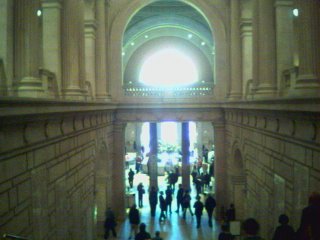
Lately I've been on a winning streak as a cultural tourist. Yesterday it was a trip to the Metropolitan Museum of Art. My brisk jog through the new Greek and Roman Galleries was delightful. But why had the museum kept so many of its antiquity highlights hidden for so long?
I was just sorry that there seems to have been some kind of a tradeoff. It seems to me that the "permanent" Oceania display has been cut back dramatically--and that was one of my favorite spots in the entire museum! So I hope I'm wrong. Perhaps I simply took a wrong turn somewhere.
Also missing (or at least moved somewhere else) were two of my favorite paintings. I like this, but what happened to the (compositionally similar) painting that had occupied its position? And what of that young couple running in the rain??
Anyway, the main reason I am posting this is to praise the Met, not to bury it. The special exhibition on Barcelona and Modernity is wonderful. It surveys the culture that nourished Pablo Picasso and also includes a marvelous stretch devoted to Antoni Gaudí's work and other high points in Barcelona design and architecture. The works in that section alone are worth a visit. The exhibition might be a tad simplistic in hewing closely to a narrative that shows an extraordinary flowering of Barcelona culture painfully cut short by the rise of Franco--and I got a little miffed at the emphasis on Dalí (a.k.a. Avida Dollars) to the detriment of other creative types (i.e. Buñuel and Llorca) who started their careers in the same circle--but this collection of works is very much worth seeing (some are achingly beautiful) and the show's Spanish orientation is a welcome alternative to the more typical France- or Paris-centered view of European art during the same period.
Here's one of the Gaudí pieces in the show, which closes on June 3, 2007.
Also at the museum are indoor and outdoor displays of work by Frank Stella. The interior display is just great, featuring a bunch of large architectural/sculptural works inside a room that can barely contain them. It's very unusual to see sculpture displayed in such a way--and it really comes off well. I didn't even make it to the outdoor display at the rooftop garden, but Scoboco gives that a good writeup, too.
The Stella work reminded me of Diabolik's lair in the stylish movie Danger: Diabolik, shown on Mystery Science Theater 3000.
Antoni Gaudí (1852–1926) Double Folding Screen from Casa Milà, 1909 Oak, metal, and frosted glass; 78 1/2 x 160 in. (190 x 400 cm) Private collection, courtesy the Allan Stone Gallery, New York



 Posts
Posts

